admin
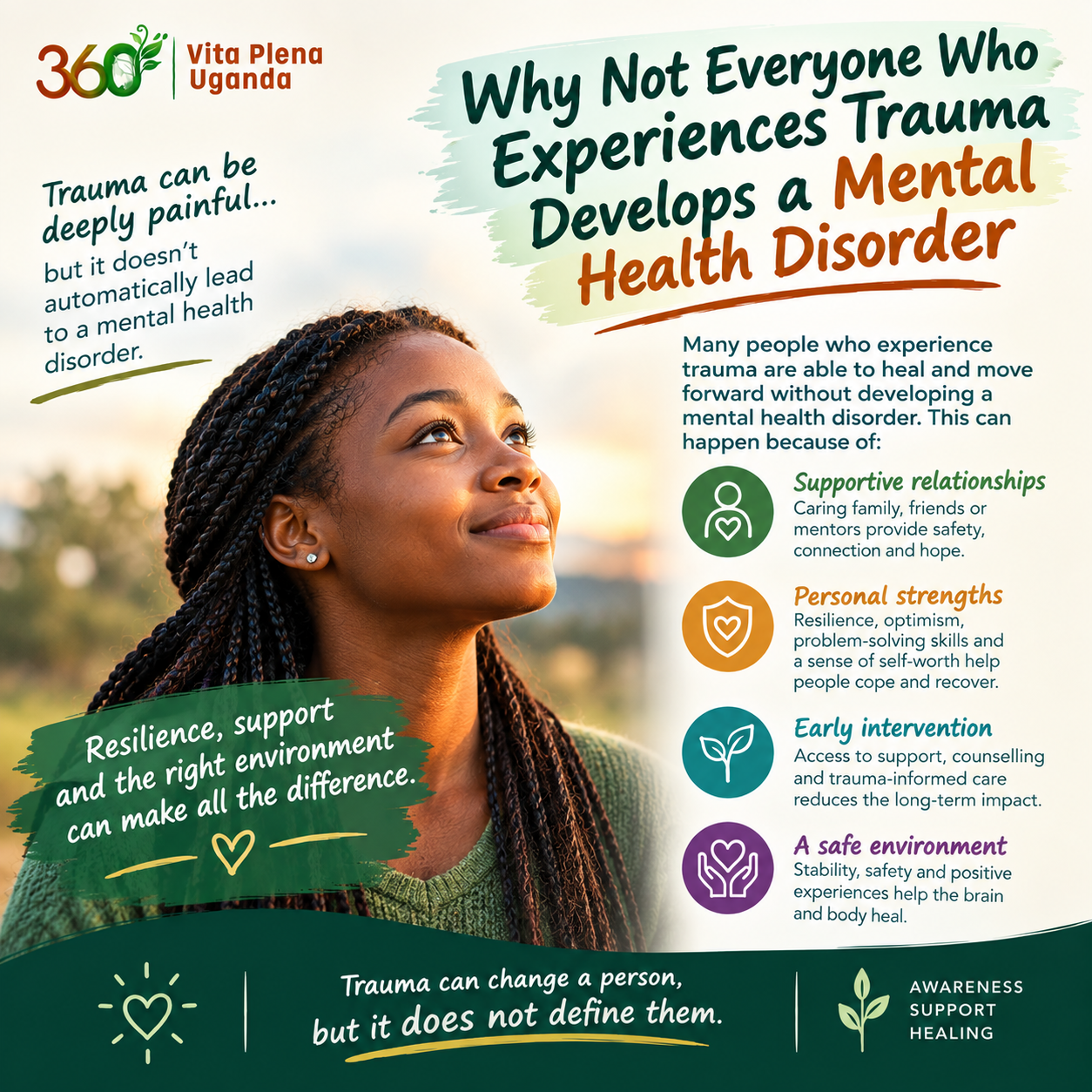
If trauma and mental health are so closely connected, a natural question follows: why do some people who live through terrible experiences go on to develop lasting struggles, while others seem to carry the same weight and remain remarkably well? The honest answer is that trauma does not follow a fixed formula. It is shaped by far more than the event itself.
Trauma is not the event — it’s the impact
The first thing to understand is that trauma is not defined by what happened, but by what it did to the person who lived through it. Two people can experience the very same event — the same loss, the same violence, the same disaster — and be affected in entirely different ways. One may carry lasting wounds; another may process it and move forward with relatively little lasting harm. This is not a matter of one person being “stronger” or “weaker” than the other. It reflects a whole set of factors working together.
What shapes the outcome
Several things influence whether an experience leaves a lasting mark:
- Age and stage of development. The younger a child is, the more vulnerable certain parts of the developing brain are to harm. Trauma experienced from birth to around two years old affects the brainstem differently than trauma experienced between ages one and five, which affects the amygdala and hippocampus, or trauma after age four, which affects the reasoning parts of the brain. The brain continues developing until around age twenty-five, meaning the timing of an experience matters as much as the experience itself.
- The presence of safe relationships. A child or adult who has even one stable, caring, trustworthy person nearby is far better protected than someone facing hardship entirely alone. Connection is one of the strongest buffers against lasting harm.
- Whether the experience was a single event or repeated. A single traumatic event and a prolonged pattern of repeated trauma — especially within relationships that should have been safe — tend to leave different kinds of marks, sometimes described using terms like PTSD and Complex PTSD.
- Support received afterward. How people around a survivor respond in the aftermath — with compassion or with blame, with patience or with silence — has a powerful effect on recovery.
- Personal meaning and interpretation. The story a person tells themselves about what happened — “this happened because I was weak” versus “this happened because I was in danger and I survived” — shapes how deeply the experience settles into their sense of self.
Resilience is real
None of this is meant to minimize trauma or suggest it should simply be “gotten over.” It is meant to highlight something equally true and often overlooked: resilience is real, and it is more common than we sometimes assume. Many people live through genuinely difficult, even devastating, experiences and continue to function with a strong sense of self-worth, stable relationships, and a settled inner life. This is not because their pain didn’t matter, but because something — a relationship, a faith, a community, an inner strength — helped carry them through it.
Why this matters for how we support people
Understanding this variability changes how we approach care in a few important ways:
- We stop assuming that hardship automatically equals disorder, which helps us avoid unnecessarily pathologising people who are coping well.
- We stop assuming that someone who is struggling is simply “weak,” recognising instead that unhelped trauma, not personal failure, is often behind the struggle.
- We recognise the enormous value of prevention — building safe relationships, safe schools, safe churches, and safe communities before hardship ever strikes, so that when it does, people have support already in place.
- We understand that timely, compassionate support after a difficult experience can significantly shift the outcome, for better or worse.
A both/and truth
Trauma is serious, and it deserves to be taken seriously wherever it appears. At the same time, human beings are remarkably capable of healing, adapting, and even growing stronger through hardship, especially when they are not left to carry it alone. Holding both truths together — the reality of trauma’s impact, and the reality of human resilience — is what allows us to respond to every person we meet with both compassion and hope.